IPFS + Smart Contracts: The Ultimate Guide to Storing and Managing Data on Blockchain
💡 Why Can’t Blockchains Store Large Files?
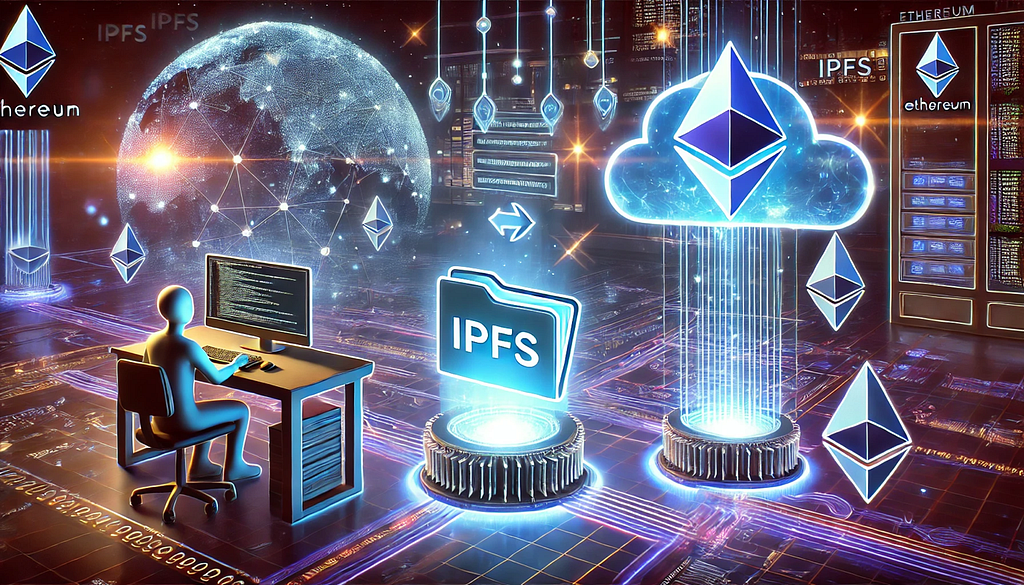
💡 Why Can’t Blockchains Store Large Files?
Blockchains are revolutionary for data integrity, but they are not designed for storing large files. Each transaction on Ethereum, Solana, or Polygon must be validated by every node, making on-chain storage expensive and inefficient.
🔴 Storing just 1GB on Ethereum can cost over $17M!
🔴 On-chain storage increases gas fees, making applications unusable.
💡 Solution? Use IPFS (InterPlanetary File System) for decentralized storage!
IPFS + Smart Contracts allow developers to store data efficiently, reduce costs, and keep blockchain applications fully decentralized. In this guide, you’ll learn:
✅ How IPFS works and why it’s essential for Web3.
✅ How to connect IPFS with smart contracts on Ethereum & Polygon.
✅ Step-by-step tutorial to store, retrieve, and manage files using IPFS.
What is IPFS and Why is It Essential for Web3?
IPFS (InterPlanetary File System) is a decentralized, peer-to-peer protocol for storing and sharing data across a distributed network. Instead of relying on a single server, IPFS splits data into content-addressable chunks and distributes them among nodes.
How it works:
📌 Content Addressing — Each file gets a unique cryptographic hash (CID) instead of a location-based URL.
📌 Decentralization — No single point of failure; files are stored across multiple nodes.
📌 Permanent Storage — Unlike traditional hosting, IPFS ensures files stay online as long as they are pinned or accessed regularly.
🔥 Example: Instead of https://example.com/image.png, IPFS uses:
ipfs://QmX4d5…fF2nY (CID that uniquely identifies the file).Why Can’t Blockchains Store Large Data?
Blockchains like Ethereum were never meant for large data storage due to:
🔴 High Costs — Storing 1MB on Ethereum can cost $17,000+ in gas fees.
🔴 Scalability Issues — Every node must store and verify all data, leading to bloated blockchains.
🔴 Fixed Storage — Data on-chain is immutable and expensive to update.
💡 Solution? Store only the IPFS hash (CID) on the blockchain while keeping actual files on IPFS!
How to Connect IPFS with Smart Contracts (Step-by-Step)
🔸 Step 1: Upload a File to IPFS
The easiest way to interact with IPFS is through Pinata or web3.storage.
Using Pinata (No Code Required)
1️⃣ Sign up on Pinata.
2️⃣ Upload a file (image, JSON, text).
3️⃣ Copy the generated CID (e.g., QmX4d5…fF2nY).
Using JavaScript & IPFS API
const ipfsClient = require('ipfs-http-client');
const ipfs = ipfsClient.create({ host: 'ipfs.infura.io', port: 5001, protocol: 'https' });

async function uploadFile() {
const file = await ipfs.add('Hello, Web3!');
console.log('File CID:', file.path);
}
uploadFile();
🔸 Step 2: Store IPFS Hash in a Smart Contract
Solidity Contract Example (Ethereum)
// SPDX-License-Identifier: MIT
pragma solidity ^0.8.0;

contract IPFSStorage {
string public ipfsHash;

function storeHash(string memory _hash) public {
ipfsHash = _hash;
}

function getHash() public view returns (string memory) {
return ipfsHash;
}
}
🔹 Deployment: Use Remix, Hardhat, or Truffle to deploy on Ethereum, Polygon, or Binance Smart Chain.
🔹 Gas Cost: Storing an IPFS hash is ~20,000x cheaper than storing raw data on-chain!
🔸 Step 3: Retrieve & Display IPFS Data in a Web3 App
Front-End (Web3.js)
const contract = new web3.eth.Contract(ABI, CONTRACT_ADDRESS);

async function fetchIPFSHash() {
const hash = await contract.methods.getHash().call();
console.log('IPFS Hash:', hash);
document.getElementById('image').src = `https://ipfs.io/ipfs/${hash}`;
}
fetchIPFSHash();
Real-World Use Cases of IPFS + Smart Contracts
🔥 1. Decentralized NFT Storage
- Problem: NFTs stored on centralized servers (AWS, Google Drive) can disappear!
- Solution: Store NFT metadata on IPFS to ensure permanent ownership.
- Example: OpenSea, Rarible, and Foundation use IPFS for NFT metadata.
🔥 2. Immutable DAO Records
- Problem: DAO decisions & governance votes must be transparent.
- Solution: Store proposals and results on IPFS, reference them in smart contracts.
- Example: Aragon DAOs use IPFS for proposal storage.
🔥 3. Web3 Content Hosting
- Problem: Websites hosted on centralized servers can be censored.
- Solution: Deploy static sites on IPFS + ENS (Ethereum Name Service).
- Example: Mirror.xyz uses IPFS for decentralized blogging.
Challenges & Limitations of IPFS
❌ File Persistence — If no one “pins” the file, it can be lost. (Solution: Pinata, Filecoin, Arweave)
❌ Slow Retrieval — IPFS isn’t always as fast as centralized servers. (Solution: Use IPFS gateways like Cloudflare or Infura)
❌ Data Updates — IPFS is immutable; changing content requires uploading a new version.
Final Thoughts: Why You Should Use IPFS with Smart Contracts
✅ Gas Fee Savings — On-chain storage is expensive, IPFS reduces costs by 99%.
✅ Decentralization — No reliance on a single point of failure (AWS, Google Cloud).
✅ NFT & Web3 Compatibility — Used by OpenSea, Aragon, ENS, and Mirror.
🚀 Want to future-proof your Web3 dApp? Combine IPFS & smart contracts for true decentralization!
🔗 Did you find this guide useful? Share your thoughts in the comments!
IPFS + Smart Contracts: The Ultimate Guide to Storing and Managing Data on Blockchain was originally published in The Capital on Medium, where people are continuing the conversation by highlighting and responding to this story.